NOIR
2009 · Multimedia / dance / theater mystery · Voorhees Theatre
In the instant before his death, a Hollywood filmmaker tries to identify the person who is about to kill him. NOIR, written by Kalle Macrides and directed by Cory Einbinder, unfolded that suspended moment through heightened language, movement, live music, video, frames, and deep stage shadows.
A cinematic landscape onstage
The company described the piece as a deconstruction of film-noir aesthetics and a modern morality play. Its central figure maneuvered among femmes fatales and violent enforcers while using a filmmaker’s familiar tools: time could rewind, images could be reframed, and a scene could repeat from another angle. The challenge was to translate those camera ideas into a shared live space.
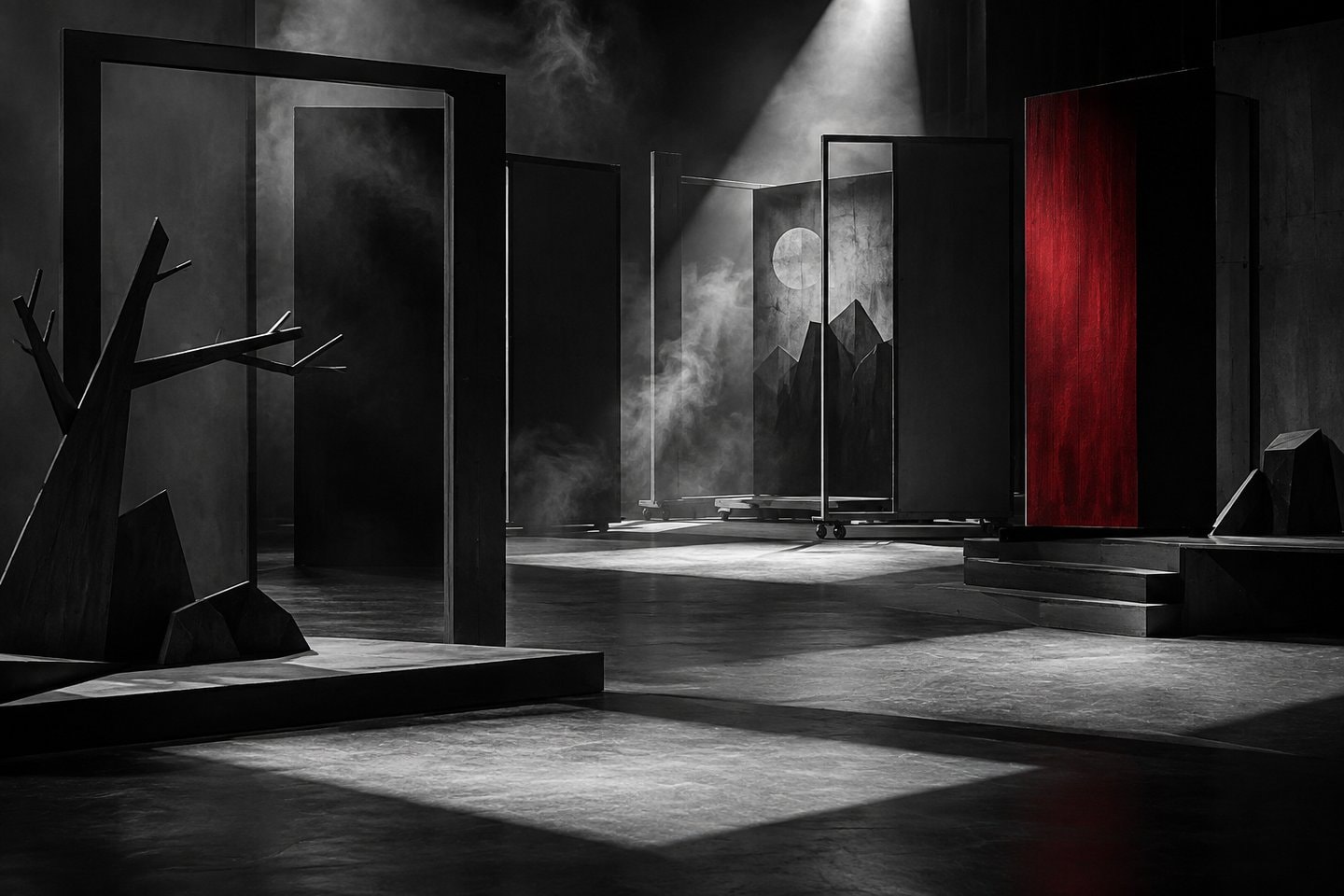
The production’s design answered with rectangles. Rolling panels and screens divided the stage. Furniture and props appeared flat and angular. Objects such as cups, bottles, and a briefcase were rendered as wooden cutouts, with magnets helping them stand in the linear setting. The actors supplied depth inside a world that treated most other things as planes and frames. Movement and lighting shifted the audience’s attention as an edit might shift a viewer’s eye.
Creative team
- Kalle Macrides — playwright
- Cory Einbinder — director, production designer, musical director, and contributing video designer
- Laura Peterson — choreographer
- Deborah Hertzberg — costume designer
- James Hergen — lighting designer
- David B. Smith — sound designer
- Linsey Bostwick — video designer and assistant sound designer
- Tara Gladden — musical director and collaborative composer
- Nicole D’Agostino — band leader and collaborative composer
- Allison Lyman — dramaturg
- Drae Campbell — assistant director
- Sarah Conyers — production manager
- Toija Riggins — stage manager
- Jared Mezzocchi — interactive systems
- Brittany Vaughan and Ophra Wolf — assistant costume designers
- Kumi Ishizawa — assistant sound designer
- Travis Fraser and Feng yu Liao — assistant stage managers
Cast and musicians
The cast was Drae Campbell, Bhavna de Montebello, Corinne Donly, Stacia French, Steven Gillenwater, Joe Gregori, Christopher Hutchings, Matt Korahais, Kate Martel, Jared Mezzocchi, Debbie Troché, and Katarina Vizina.
The live ensemble featured Nicole D’Agostino on saxophone, Domenica Fossati on flute, Curt Garey on drums, Aaron Goldsmith on bass, and Gabriel Lit on clarinet. The company credits state that Nicole D’Agostino, Domenica Fossati, Curt Garey, Tara Gladden, Aaron Goldsmith, and Gabriel Lit composed the music collaboratively. The band’s placement within the design gave rhythm and atmosphere an active role in the mystery.
From reading to full production
A reading at the Voorhees Theatre in December 2008 preceded the complete production. The reading cast was Max Arnaud, Drae Campbell, Bhavna de Montebello, Ryan Edwards, Nnadi Harriot, Matt Korahais, Alanna Medlock, Jared Mezzocchi, and Katarina Vizina. By the 2009 staging, the project had developed into a collaboration joining writing, choreography, production design, interactive systems, video, sound, and a live band.
“Ingeniously designed”
BackStage
The short excerpt matches the unusual unity of the production: the world, objects, actors, and music all followed a single angular visual rule. Continue to Review Excerpts, or place the production within the full Projects & Events chronology.
One second divided into frames
The company described the visual landscape through twenty-four frames, the familiar division of a second of film. Onstage, that metaphor offered a structure for a man trying to investigate the instant of his own death. Panels could isolate an image, movement could repeat or reverse, and light could cut the room into successive views. The production did not need a literal camera edit; bodies, scenery, and cues created the edit in front of the audience.
The flat props strengthened the rule. A cup or telephone remained recognizable, but its thin angular construction made it belong to the graphic world rather than everyday domestic space. Magnets gave the objects temporary footing on linear furniture. Against those planes, the actors remained dimensional and vulnerable. The contrast between live bodies and rigid frames turned the design into part of the morality-play tension named in the company’s description.