About Adhesive Theater Project
Mission statement
Adhesive Theater Project binds the arts through the bonds of collaboration.
The company was dedicated to working with artists in a broad range of fields—from fashion designers to scientists, illustrators to engineers—to create experimental, multidisciplinary work. By challenging those artists to work in the theater, Adhesive sought new perspectives for live performance. The mission joined live music, visual art, and technological innovation with metaphor and narrative storytelling in order to make large imaginative experiences onstage.
The incomplete art
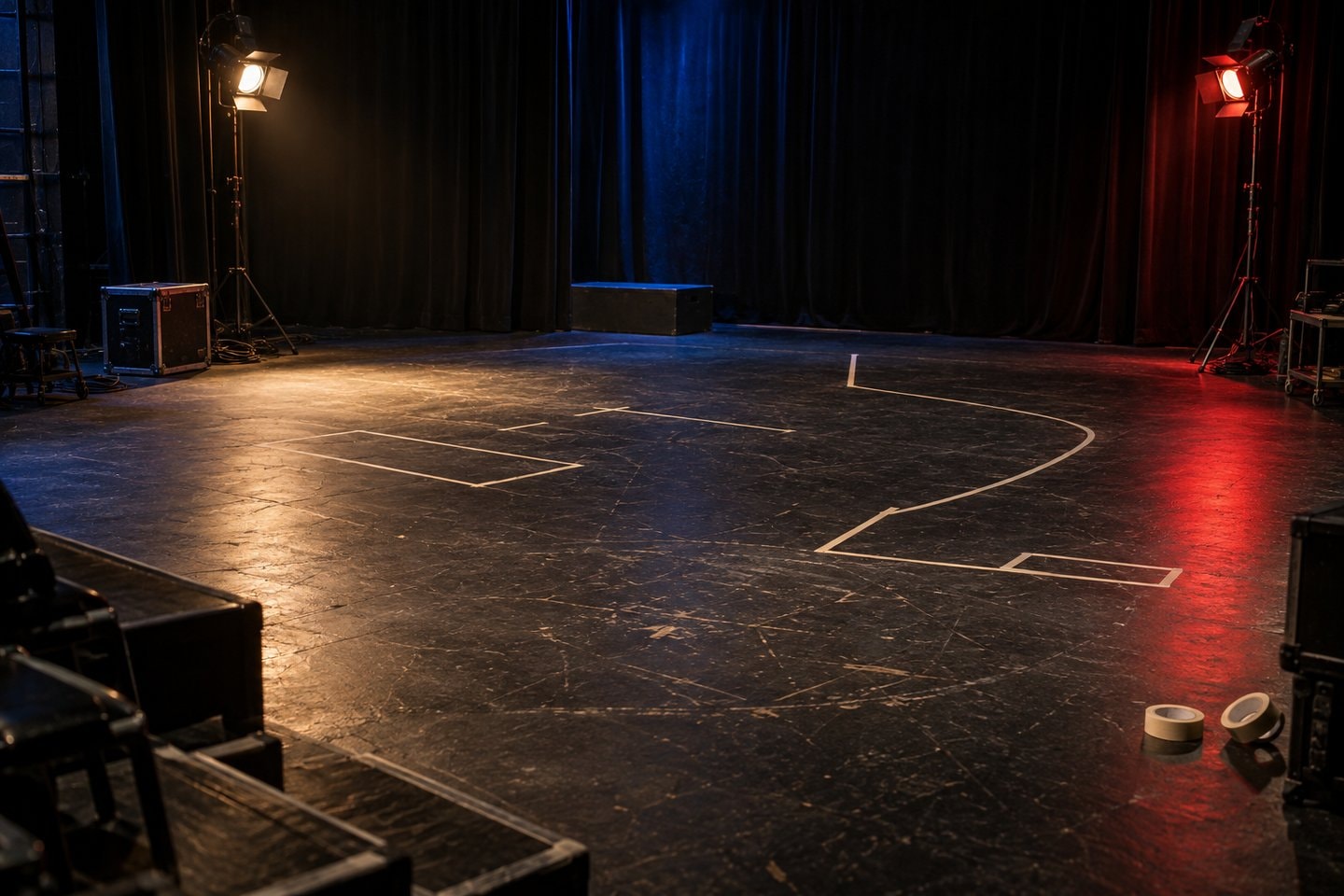
Adhesive held that theater gains strength from what it cannot literally supply. A stage begins as an empty surface. Sets, costumes, bodies, lights, sounds, and devices establish a world, but an audience completes it. A backdrop can become a forest; a piece of cloth can become a bird; a flat frame can become a camera view. The gap between object and idea is not a defect. It is the place where the audience makes a leap of faith.
That position also explains the company’s resistance to treating film realism as the standard a stage should imitate. Theater could instead use its own conventions: animals could speak, a person could fly, an object could insist on a life of its own, and a puppet could make a projected face part of its body. The productions repeatedly exposed the pleasure of those transformations rather than hiding every seam.
Scale, focus, and timing give the audience clues to an imagined world. A small figure held close to a light can cast a large shadow; moving the figure changes both the image and the visible act that makes it. A sound before an entrance can direct attention toward an empty space, while the same sound after an entrance can appear to answer a movement. Trying those sequences separately makes their dramatic differences apparent. The practical question is what the audience has been given enough information to imagine. Adding another device is only one option; changing when an existing image or sound appears can change the relationship between them.
Production history
The company described itself as developing original multimedia productions and play adaptations from 2000 onward. The Battles of Coxinga came earlier, in 1999. Spring Awakening and Kirby followed in 2000. In 2002, Les Mauvais Garçons entered HERE Arts Center’s American Living Room series and returned for additional performances. Figaro Gets a Divorce followed in 2004.
In 2005 the company presented both Hysteria: HYSTERIA and Chantecler. The latter put ten performers to work across more than one hundred animal characters through masks, puppetry, physical theater, live drawing, and an original score. The following year brought R.U.R.: A Futurist Folk Opera and the first Brooklyn Robot Parade. I, Object! played at The Brick in 2008, followed by a reading and then the full 2009 production of NOIR.
Adhesive marked its tenth year in 2009 with an event joining music and dance with longtime collaborators. In January and February 2013 the company presented the world premiere of Erin Courtney’s The Service Road, directed by Meghan Finn, at the Voorhees Theatre at New York City College of Technology.
Recognition
Les Mauvais Garçons was selected for the Best of the American Living Room series at HERE Arts Center. The live video tracking system used in NOIR drew published attention, and The Service Road took part in the 2012 Prelude Festival before its full production.
For names and responsibilities, see Company Officers and the credit lists on each production page. For the full sequence, including smaller events, visit Projects & Events.
Collaboration as a design tool
The production credits make “collaboration” concrete. An illustrator does more than provide an image before the show; in Chantecler, drawings arrived during the performance. A musician does more than supply background; in NOIR, the band’s hard-edged sound belonged to the world’s rhythm. A video designer does more than fill a screen; in The Service Road, projected faces became characters attached to sculptural forms.
This way of working gives each discipline a dramatic task. Puppetry can shift scale, live video can change point of view, music can drive movement, and a constructed object can determine how a performer crosses the stage. The audience sees a story and also senses the negotiated work that holds it together. That double view—fiction and visible making at once—is one of the clearest links across the company’s history.