R.U.R.: A Futurist Folk Opera
2006 · Workshop production · Spring Theatreworks
Adhesive Theater Project approached Karel Čapek’s robot drama through the collision of folk opera, contemporary dance, live band music, film, and sculptural design. The workshop production treated the robot as both an idea from a classic play and a handmade theatrical body.
Reimagining the source
The production was written and directed by Cory Einbinder, with music and lyrics by Joel Griffin and Cory Einbinder, and based on Čapek’s R.U.R. Its stated palette blended rock, tango, jazz, and punk with movement. Those forms brought the source into a present-tense stage vocabulary without hiding the age of the play beneath realistic scenery.
The company connected the work to the word “robot,” which entered broad use through Čapek’s play. Readers who want to compare the theatrical source can consult Project Gutenberg’s public-domain edition of R.U.R.. The resource identifies Čapek as author, gives the alternate title Rossumovi univerzální roboti, and provides the text in Czech.
Creative team
- Cory Einbinder — writer, director, choreographer, music and lyrics
- Joel Griffin — music and lyrics, music director, band
- Drae Campbell — assistant choreography
- Kalle Macrides — script development and dramaturgy
- Vinny Colombo — stage management and music transcription
- Raasa Leela de Montebello — filmography
- Saul Melman — sculptural design
- David Tanklefsky — band
- Krishna Kerwar — band
- Alex Pleasant — pre-show film
- Norm Scott — pre-show robot music
Cast
The featured performers were Max Arnaud, Peter Brown, David Eun, Talaura Harms, Kalle Macrides, Alanna Medlock, Josh Mertz, and Katarina Vizina. The band credits list Joel Griffin, David Tanklefsky, and Krishna Kerwar.
Workshop form
The April and May 2006 performances at Spring Theatreworks were explicitly described as a workshop production. That label matters. The company presented a full combination of music, dance, film, sculpture, performance, and dramaturgy while also showing a work in development.
The workshop’s robot world also moved into public space through the Brooklyn Robot Parade. Held in D.U.M.B.O. in April 2006, the parade welcomed toy robots, mechanical constructions, and handmade costumes. It turned the subject of the stage work into an open gathering where engineers, enthusiasts, families, and theater makers could meet through objects they had built.
Handmade futures
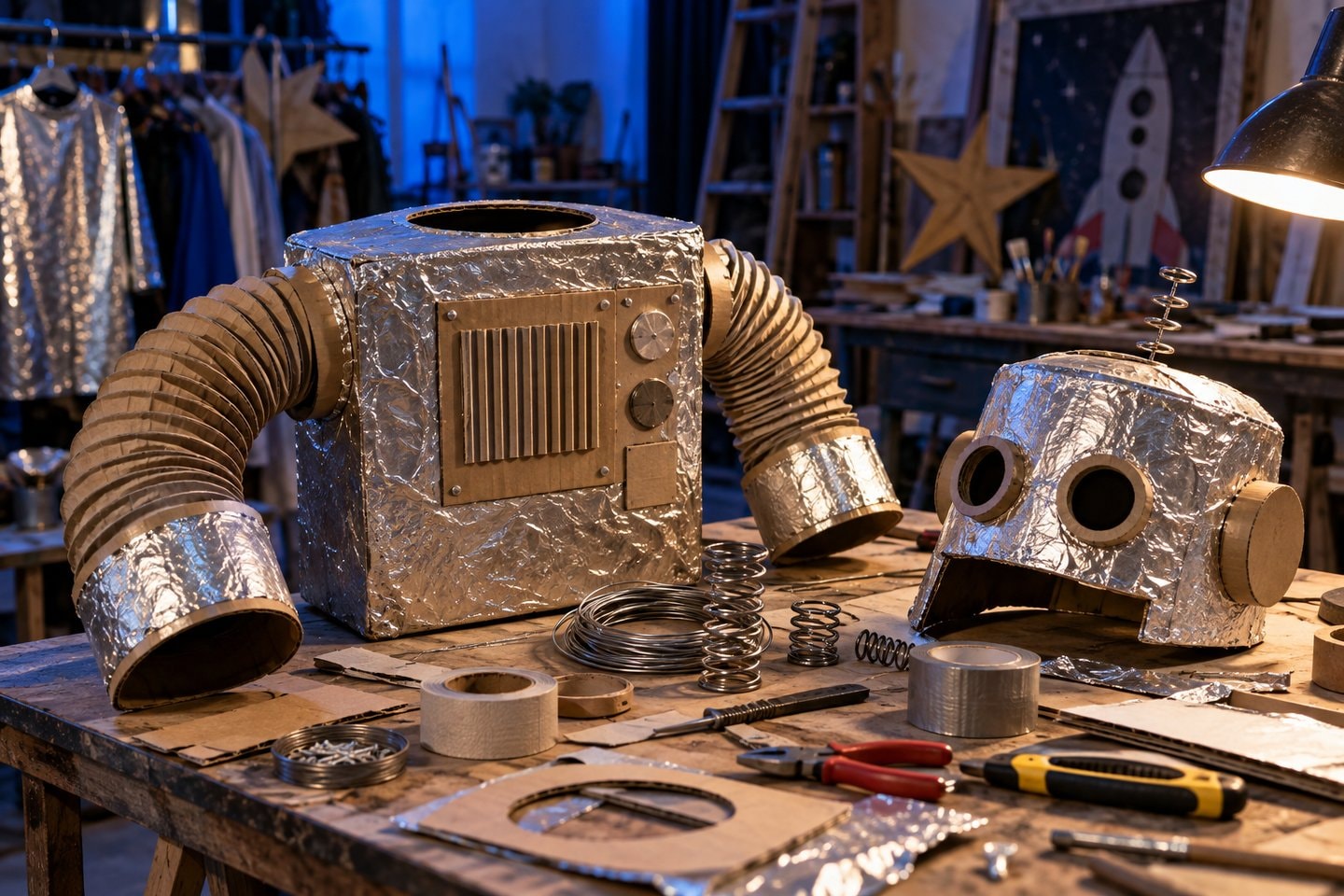
The production’s title joins two tones that might seem opposed: “futurist” and “folk.” Adhesive’s method made the connection practical. A future imagined onstage still begins with bodies, instruments, cardboard, metal, cloth, light, and time. A folk opera can carry a technological question because its tools are visible and shared. The Robot Parade extended that idea by treating invention as something people could carry down a route together.
For the neighboring projects, see Projects & Events. The general guide to performer practice around rigs, costumes, and moving structures addresses the kind of careful rehearsal such objects require.
Music as machinery
The band and movement gave the workshop another kind of mechanical system. Repeating rhythms could make an ensemble seem organized like a factory, while sudden changes could interrupt that order. Tango, jazz, rock, and punk offered different pulses and social textures. Contemporary dance gave the performers a way to embody repetition, resistance, group behavior, and individual variation without requiring realistic industrial scenery.
Film and sculpture widened the same inquiry. A pre-show film could introduce a robot image before live bodies entered, while constructed forms gave the idea weight in the room. The workshop title’s “folk opera” kept the human act of playing and singing beside the technological subject. Even the future was made in real time by musicians, performers, operators, and visible materials.