Chantecler
2005 · Teatro LA TEA · Translated by Kay Nolte Smith
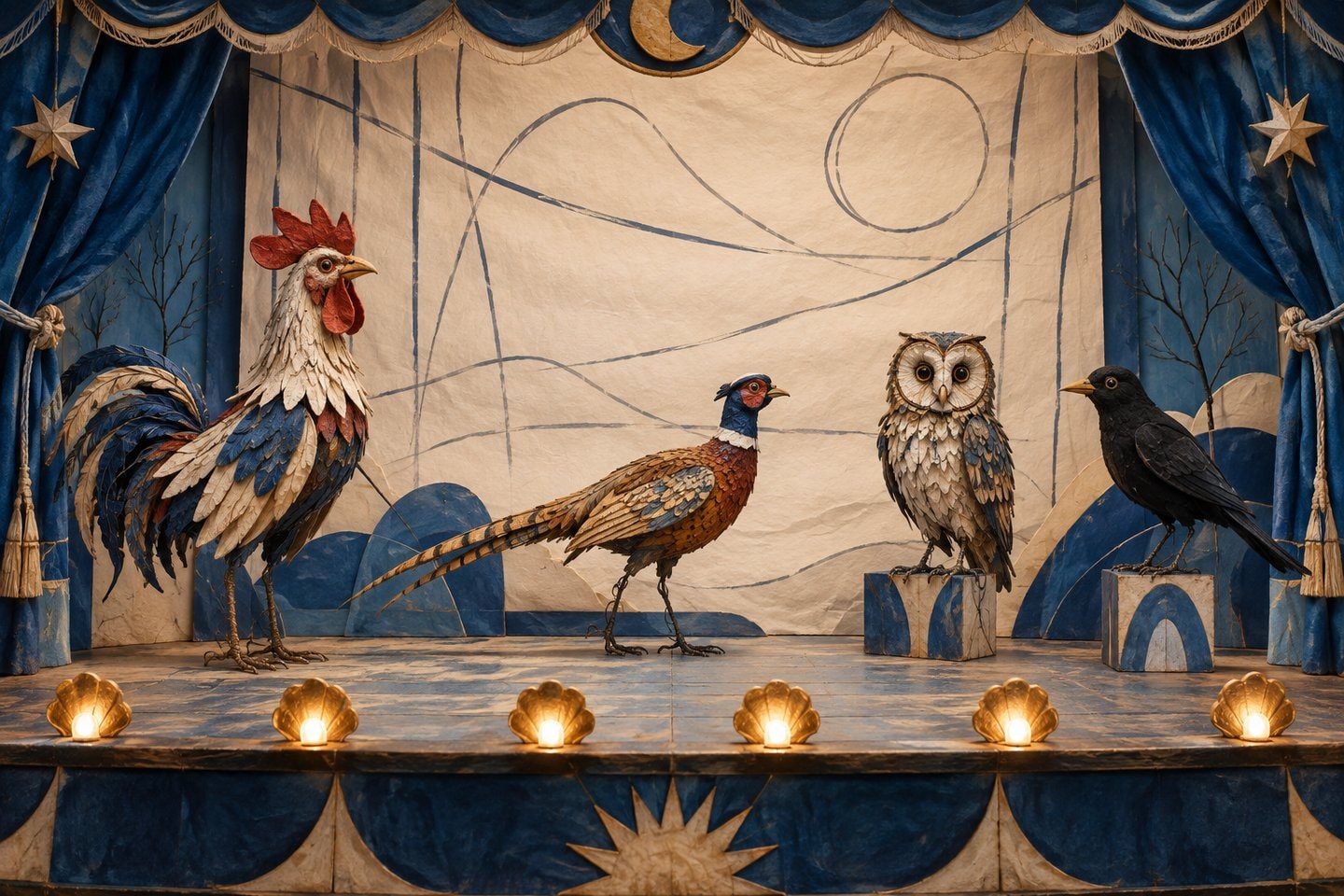
A rooster believes his song makes the sun rise. Adhesive Theater Project staged Edmond Rostand’s animal allegory as a world of puppets, masks, live illustration, physical theater, and original music, with ten actors playing more than one hundred characters.
The play and the production
The company’s synopsis centered on inspiration, finding a place in society, and meeting doubt and fear. Chantecler’s belief gives the theatrical premise a simple engine: the audience sees an animal figure, hears a human performer, and enters a world where a song can be responsible for sunrise. That leap of faith aligns closely with Adhesive’s stated idea of theater as an incomplete art completed by the imagination.
The production used a three-piece band performing an original score. Two visual artists drew the world of the play as it unfolded, using projection to let marks arrive alongside the actors. Puppets, masks, wings, costumes, movement, light, and music divided the animal population among ten performers. The design did not aim to disguise its multiplicity. It made the changing theatrical means part of the event.
The Académie française’s record for Edmond Rostand lists Chantecler among his works in 1910. Adhesive presented the play in Kay Nolte Smith’s translation at Teatro LA TEA in 2005.
Creative team
- Edmond Rostand — playwright
- Kay Nolte Smith — translator
- Cory Einbinder — director and contributing puppeteer
- Alicia Arinella — producer
- Diana Whitten — art director and puppeteer
- Todd Smith — technical director
- Shari Johnson — assistant director and puppeteer
- Jonathan Zeh and James Harley — illustrators
- James Bedell — lighting designer
- Joel Griffin, Rob Caruso, and Damien Lennon — composers and musicians
- Suzanne Chesney — costume designer
- Jeff Stark — special projects
- Brian Matthews — puppet master and wing builder
- Christiaan Koop — puppets and costumes
- Kalle Macrides — script editor
- Talaura Harms — puppeteer
- Vinnie Colombo — stage manager
- Artie Stiles — technical advisor
- Maria Gust — postcard image
Cast
The cast was Drae Campbell, Charles Goonan, Talaura Harms, Jessica Jolly, Kalle Macrides, Josh McLane, Alanna Medlock, Madeline Muravchik, Orion Taraban, and Aaron Mostkoff Unger. The ensemble shared the many animal roles.
The Farmyard Puppet Workshop
Two Sunday workshops accompanied the run. Participants worked with materials related to the production and a section of the script, then explored the creation and manipulation of masks and puppets. The workshop extended the production’s method beyond watching. It made construction and operation part of understanding how an animal figure becomes a character.
“especially memorable... creative, interesting... witty...”
New York Times
The excerpt sits beside other responses on Review Excerpts. In the larger history, Chantecler forms a bridge between the shadow-puppet action of The Battles of Coxinga and the built mechanical bodies of R.U.R..
Drawing a world in real time
The live illustrators added an unusual clock to the performance. A completed backdrop presents a place all at once; a drawing made during the play reveals a place as a sequence of marks. The audience can watch an outline arrive, recognize an animal or landscape, and then see the performers respond within the projected image. That shared timing turns illustration from decoration into an event.
Puppetry created a similar double perception. Cloth, papier-mâché, wings, masks, and rods remained material objects, while the ensemble’s focus and movement allowed them to become birds and other animals. Ten actors could cross among more than one hundred characters because identity was distributed through voice, silhouette, rhythm, and construction. The three-piece band supplied continuity as the visible forms changed.
The related puppet workshop made that transformation available at tabletop scale. Building a figure from the show’s materials gave participants a direct way to test how shape, balance, and manipulation alter a character before the finished production began.