Spring Awakening
2000 · Center Stage · Frank Wedekind in a version by Ted Hughes
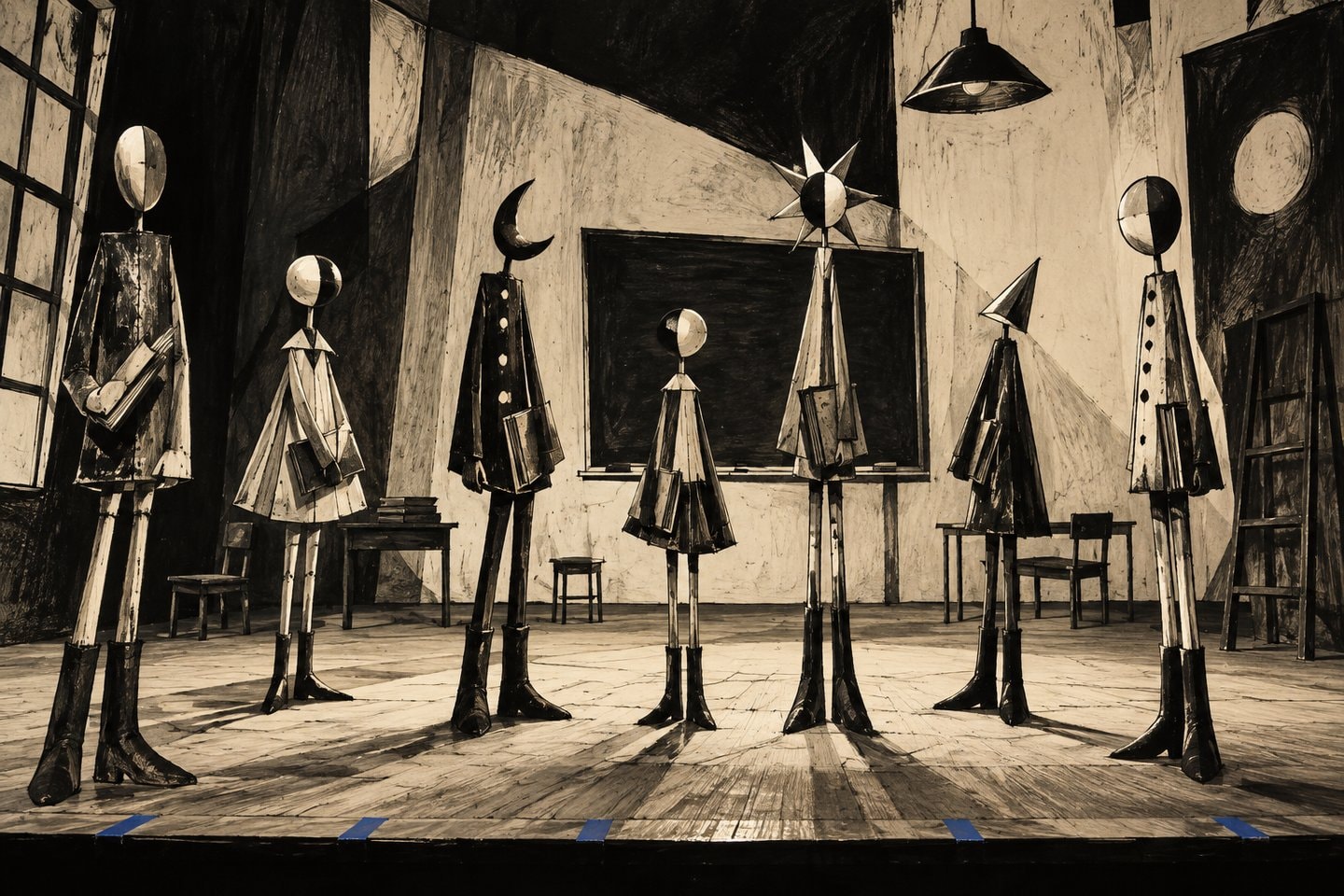
Adhesive Theater Project’s Spring Awakening placed seven actors in a dark, painted stage world where they played twenty-six characters. Stark shadow and light, a detailed soundscape, hand-painted surfaces, and towering adult figures made the production’s social pressure visible.
The staging
The production was conceived and directed by Cory Einbinder. The company’s description connected the visual world to dark comic line work and elegant inking. Sets, costumes, and performers were painted as parts of one environment. The adult characters and teachers appeared as large figures in oversized boots, changing the scale between young people and authority.
The choice made the stage both story and drawing. A performer could move through a field of black and cream, while light sharpened or erased edges. Sound supplied another dimension to the visual lines. With seven actors carrying many roles, transformation itself became a recurring event. The audience did not need a separate realistic room for every location; costume, posture, scale, rhythm, and image did the work.
Creative team
- Frank Wedekind — playwright
- Ted Hughes — version
- Cory Einbinder — conception, direction, sets, props, and lighting
- Rachel Schulman — stage manager
- Joel Griffin — music and sound
- Paata Uta Bekaia — costumes and additional art
Cast
The cast was Max Arnaud, Maha Chehlaoui, Tim Cusack, Kalle Macrides, Alanna Medlock, Grant Moninger, and Matthew Pritchard.
A compact run, a large visual vocabulary
The production opened in September 2000 and closed in October at Center Stage. That short run produced one of the company’s most frequently repeated review excerpts:
“Nothing short of extraordinary... Stunningly theatrical, moodily evocative, and even a little scary at times, this Spring Awakening crackles with invention and intelligence.”
NYTheatre.com
The words point to the same features named by the company: the painted environment, the scale of the adults, the soundscape, and a stage composition built from shadow and light. The response later became a concise way Adhesive introduced its work across newsletters and production pages.
From early work to later spectacle
Spring Awakening shows several tools that returned in later productions. Chantecler expanded the transformation of a small cast through puppets and masks. NOIR gave the entire stage a strict graphic rule. The Service Road used inclined scenery and projected faces to produce another expressionist environment. Across those projects, a visual system shaped performance rather than serving as background.
Return to Projects & Events for the full production chronology or visit Review Excerpts for the company’s short selected lines.
Scale, paint, and authority
The towering adult figures made a social relation visible before a line needed to explain it. Their height, heavy steps, and painted surfaces changed the young characters’ space. Because the same small ensemble moved among many roles, scale helped the audience identify a shift from child to parent or teacher. The world could change through a costume element and a physical score instead of a complete scenic replacement.
Paint connected body and setting. When performers, costumes, props, and scenery share a graphic treatment, the boundary between a person and the surrounding picture becomes unstable. A figure can seem trapped inside the composition, then break its line through movement. Joel Griffin’s sound and the lighting design added duration and depth to that image, allowing a two-dimensional visual idea to unfold as live theater.
The result established an early company pattern: one coherent visual rule could organize acting, scenery, costume, sound, and light. Later productions changed the rule, but they kept treating design as a way to think through the play rather than a surface added around it.